What if your child could build confidence, problem-solving skills, and creativity before they even start school?
The good news: they already can.
Every time your child mixes colours, stacks blocks, or asks “why?”, they’re engaging in STEM learning. And you don’t need expensive kits or structured lessons — just simple everyday activities and a little curiosity.
In this guide, you’ll discover 10 simple STEM activities for preschoolers that you can start today using items you already have at home.
What Are STEM Activities for Preschoolers?
STEM activities for preschoolers are play-based learning experiences that introduce science, technology, engineering, and maths through hands-on exploration, problem-solving, and curiosity.
These activities help children aged 3–5:
- Ask questions and think independently
- Explore how things work
- Build early maths and science understanding
- Develop confidence through trial and error
If you’re new to the concept, you can also read our guide on what STEM education in early childhood means and why it matters, where we break down how STEM supports your child’s development from an early age.
Why STEM Is Important in Early Childhood
The ages between 3 and 5 are one of the most critical stages of brain development.
During this time, children develop:
- Critical thinking and problem-solving skills
- Fine motor coordination
- Language and communication skills
- Early numeracy and science concepts
- Confidence and resilience
STEM learning doesn’t feel like “learning” to a child — it feels like play. And that’s exactly why it works.
10 STEM Activities for Preschoolers to Try This Week
Here’s a quick overview of easy STEM activities for preschoolers, including difficulty level and time required:
STEM Activities for Preschoolers (Quick Comparison Table)
| Activity | Difficulty | Time Required | Key Learning Areas |
|---|---|---|---|
| Sink or Float Challenge | Easy | 10–15 mins | Prediction, density, observation |
| Colour Mixing Experiment | Easy | 10–15 mins | Colour theory, cause & effect |
| Build the Tallest Tower | Easy–Medium | 15–20 mins | Engineering, balance, problem-solving |
| Ice Rescue Mission | Medium | 20–30 mins (+ prep) | States of matter, strategy |
| Nature Pattern Hunt | Easy | 20–30 mins | Classification, observation |
| Homemade Playdough Lab | Medium | 20–25 mins | Measurement, material changes |
| Magnetic or Not? | Easy | 10–15 mins | Magnetism, sorting |
| Grow Your Own Plant | Medium | 10 mins + daily | Life cycles, responsibility |
| Shadow Tracing Science | Easy | 10 mins (multiple times) | Light, shadow, time |
| Rain Cloud in a Jar | Easy–Medium | 10–15 mins | Weather, density |
1. Sink or Float Challenge
Difficulty: Easy
Time: 10–15 minutes
Fill a tub with water and test objects like a spoon, leaf, coin, or toy.
Ask: “Do you think this will sink or float?”
What they learn:
- Prediction and observation
- Basic physics concepts (density)
- Vocabulary (heavy, light, float)
2. Colour Mixing Experiment
Difficulty: Easy
Time: 10–15 minutes
Use coloured water (red, blue, yellow) and let your child mix them.
Ask: “What do you think will happen?”
What they learn:
- Cause and effect
- Colour theory
- Fine motor skills
3. Build the Tallest Tower
Difficulty: Easy–Medium
Time: 15–20 minutes
Use blocks, boxes, or household items. Let it fall — then rebuild.
What they learn:
- Engineering basics
- Balance and structure
- Problem-solving
4. Ice Rescue Mission
Difficulty: Medium
Time: 20–30 minutes (plus freezing time overnight)
Freeze small toys in ice. Let your child “rescue” them using warm water, salt, or tools.
What they learn:
- States of matter
- Temperature effects
- Patience and strategy
5. Nature Pattern Hunt
Difficulty: Easy
Time: 20–30 minutes
Go outside and collect items like leaves, sticks, and rocks. Sort them by texture, shape, or colour.
What they learn:
- Observation
- Classification
- Nature awareness
6. Homemade Playdough Lab
Difficulty: Medium
Time: 20–25 minutes
Make playdough using flour, salt, and water. Let your child measure and mix.
What they learn:
- Measurement
- Material changes
- Creativity
7. Magnetic or Not?
Difficulty: Easy
Time: 10–15 minutes
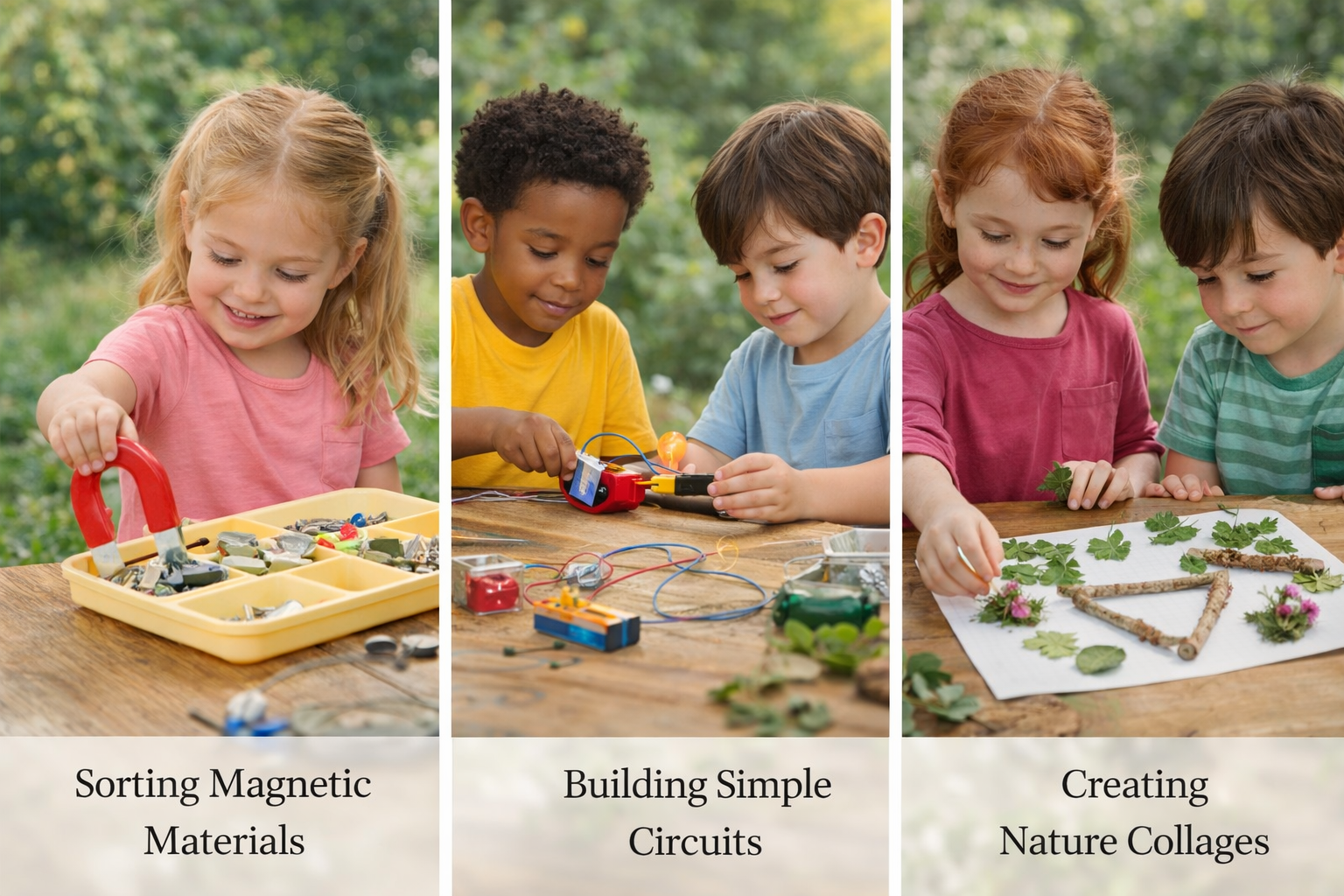
Test household objects with a magnet and sort them into magnetic or non-magnetic.
What they learn:
- Magnetism
- Sorting and grouping
- Hypothesis testing
8. Grow Your Own Plant
Difficulty: Medium
Time: 10 minutes setup + daily observation (5 minutes)
Plant seeds and track growth each day.
What they learn:
- Life cycles
- Responsibility
- Observation over time
9. Shadow Tracing Science
Difficulty: Easy
Time: 10 minutes per session (morning, midday, afternoon)
Trace shadows at different times of the day.
Ask: “Why has the shadow changed?”
What they learn:
- Light and shadow
- Earth–Sun relationship
- Measurement
10. Rain Cloud in a Jar
Difficulty: Easy–Medium
Time: 10–15 minutes
Use water, shaving cream, and food colouring to simulate rain.
What they learn:
- Weather concepts
- Density
- Visual cause and effect
How to Make STEM Activities More Effective
- Ask open-ended questions
- 👉 “What do you think will happen?”
- Let your child lead
- 👉 Avoid correcting too quickly
- Use real vocabulary
- 👉 Predict, observe, measure, compare
- Keep sessions short (10–20 minutes)
- Repeat activities
- 👉 Repetition builds deeper learning
Safety Tip for Parents
Always supervise activities, especially those involving:
- Water
- Small objects
- Tools or materials
Want Your Child to Experience STEM Every Day?
At Beginnings Early Learners, STEM isn’t just an activity — it’s part of everyday learning.
Our educators create play-based, curiosity-driven environments where children:
- Explore confidently
- Ask questions freely
- Learn through real experiences
We follow the Early Years Learning Framework (EYLF) across our centres in Alfredton and Sunbury, ensuring your child is supported every step of the way.
👉 Book a centre tour today and see the difference for yourself.