
Quick Answer – STEM education in early childhood introduces young children to science, technology, engineering, and mathematics through play-based activities. It helps children develop curiosity, creativity, problem-solving skills, and confidence while exploring how the world works.
Early childhood is a crucial stage when children naturally explore, question, and experiment with the world around them. STEM education builds on this curiosity to develop strong thinking and problem-solving skills.
In this guide, we explain what STEM education is, why it matters in early childhood, and how it supports children’s development and future learning.
What Is STEM Education?
STEM stands for:
- Science
- Technology
- Engineering
- Mathematics
STEM education combines these four subjects to help children learn how things work and how to solve problems.
Instead of teaching each subject separately, STEM encourages children to explore them together through hands-on activities, experiments, and play-based learning.
For example, when a child builds a tower using blocks, they are:
- Learning engineering by designing a structure
- Exploring science through balance and gravity
- Using math when counting blocks or measuring height
- Engaging with technology when using tools or digital learning resources
This integrated learning approach helps children understand how different ideas connect and how the world works.
Why Is STEM Important in Early Childhood?
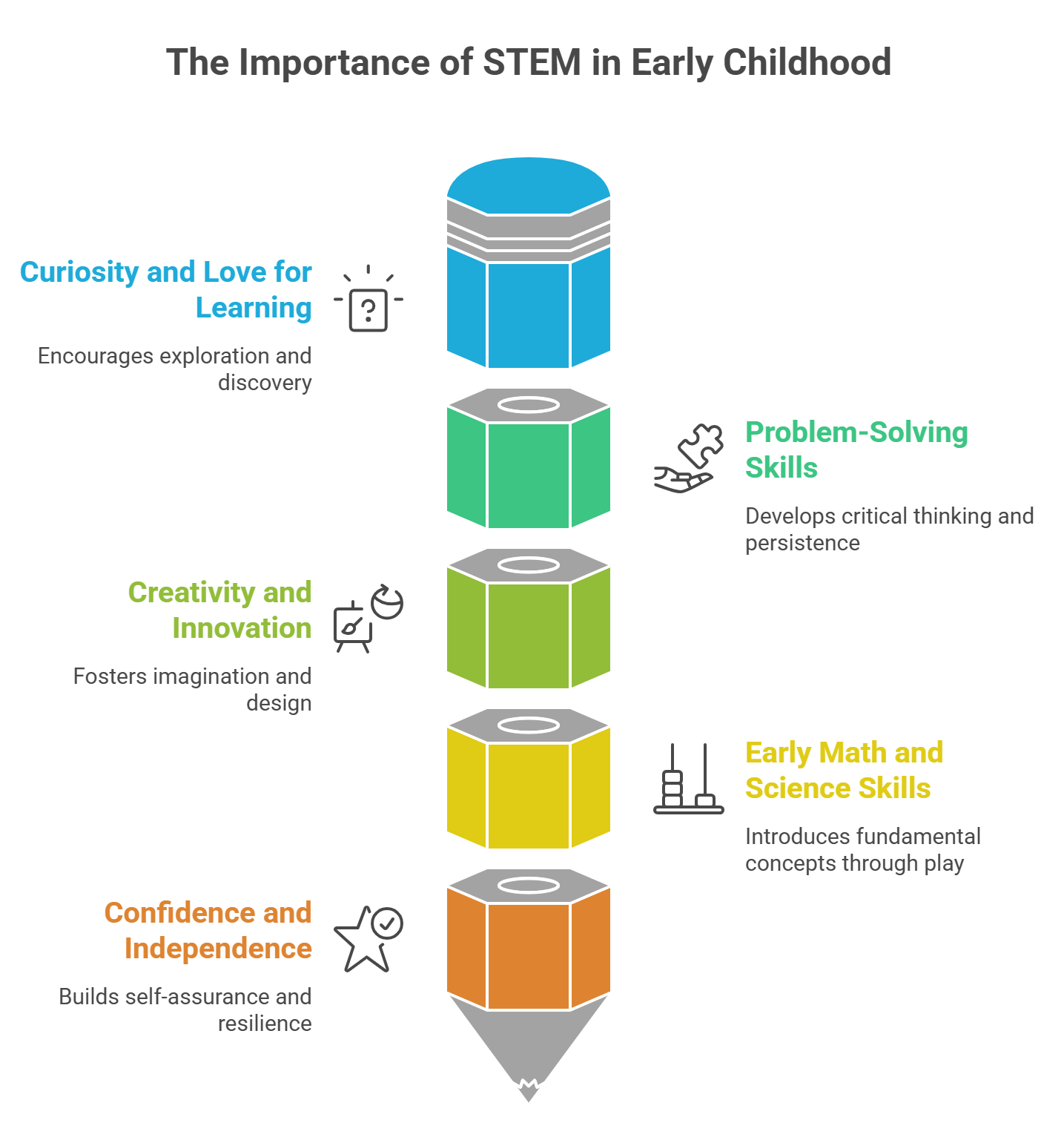
1. Builds Curiosity and a Love for Learning
Young children are naturally curious. They often ask questions such as:
- Why does rain fall?
- How do plants grow?
- Why does the tower fall down?
STEM learning encourages children to explore these questions through experimentation and discovery rather than simply receiving answers.
This process nurtures a lifelong love of learning.
2. Strengthens Problem-Solving Skills
One of the biggest benefits of STEM education is developing problem-solving abilities.
Through STEM activities, children learn how to:
- Observe and ask questions
- Try different solutions
- Test their ideas
- Learn from mistakes
For example, if a block bridge collapses, children will naturally try to rebuild it using a stronger design. This encourages critical thinking and persistence.
3. Encourages Creativity and Innovation
Many people assume STEM is only about numbers or science, but creativity plays a huge role.
Children may:
- Design a ramp for toy cars
- Build structures using recycled materials
- Create simple machines using everyday objects
These experiences encourage children to imagine, design, and create, which supports innovation and creative thinking.
4. Develops Early Math and Science Skills
STEM learning introduces important concepts in simple and engaging ways.
Children begin to understand ideas such as:
- Counting and measuring
- Patterns and shapes
- Cause and effect
- Sorting and categorising
Because these concepts are introduced through play and exploration, children learn naturally without pressure.
5. Builds Confidence and Independence
When children successfully solve problems or build something new, they gain confidence in their abilities.
STEM activities often involve:
- Teamwork
- Independent thinking
- Trying new ideas
These experiences help children become confident learners who enjoy exploring challenges.
Key Benefits of STEM Education in Early Childhood
STEM education provides several important benefits for young children, including:
- Developing critical thinking and problem-solving skills
- Encouraging curiosity and exploration
- Building early maths and science understanding
- Supporting creativity and innovation
- Strengthening communication and teamwork skills
- Preparing children for future learning and careers
How STEM Is Taught in Early Childhood
STEM learning in early childhood settings is very different from traditional classroom teaching. It focuses on play-based learning and exploration.
Educators often introduce STEM concepts through engaging activities such as:
Hands-On Experiments
Simple science activities such as mixing colours, planting seeds, or observing insects help children understand natural processes.
Building and Construction
Using blocks, LEGO, or recycled materials allows children to explore engineering, design, and structural thinking.
Nature Exploration
Outdoor learning encourages children to observe plants, weather, animals, and natural patterns.
Technology in a Balanced Way
Technology may include simple tools, educational apps, or digital storytelling that support learning without replacing hands-on experiences.
Examples of STEM Activities for Young Children
Many everyday activities can support STEM learning.
| Activity | What Children Learn |
|---|---|
| Building Structures | Engineering concepts, balance, and design |
| Water Play Experiments | Floating, sinking, and cause-and-effect |
| Gardening | Plant growth, nature, and responsibility |
| Sorting and Counting Games | Early mathematics and pattern recognition |
These STEM activities make learning exciting while encouraging children to explore new ideas.
What Skills Do Children Develop Through STEM?
When exploring STEM learning in early childhood, the benefits become clear through the skills children develop.
These include:
- Critical thinking
- Creativity
- Collaboration
- Communication
- Curiosity
Together, these skills support school readiness and lifelong learning.
At What Age Should STEM Education Start?
STEM education can begin as early as infancy through exploration and play.
For example:
- Babies explore cause and effect when dropping toys
- Toddlers experiment with stacking blocks
- Preschoolers begin building, measuring, and observing nature
The earlier children are exposed to STEM experiences, the more confident they become in exploring ideas and solving problems.
Is STEM Education Only for Future Scientists?
A common misconception is that STEM education is only useful for children who want to become scientists or engineers.
In reality, STEM skills benefit every child, regardless of their future career.
These skills help children:
- Make decisions
- Solve everyday problems
- Understand how things work
- Adapt to new challenges
Whether children grow up to become artists, teachers, engineers, or entrepreneurs, STEM thinking supports success in many fields.
Why STEM Learning Matters for Your Child
STEM education in early childhood helps children become curious, confident, and capable learners.
Through simple STEM activities like building, experimenting, and exploring nature, children begin to understand how the world works.
By encouraging STEM learning early, children develop important abilities such as:
- curiosity and creativity
- problem-solving and critical thinking
- teamwork and communication
- confidence to explore new ideas
These early experiences create a strong foundation for future learning and development.
Frequently Asked Questions About STEM Education
What is STEM in early childhood education?
STEM in early childhood education introduces children to science, technology, engineering, and mathematics through play-based learning and exploration.
Why is STEM important for preschool children?
STEM helps preschool children develop critical thinking, creativity, curiosity, and problem-solving skills, which support early learning and school readiness.
What are simple STEM activities for preschoolers?
Simple STEM activities include building block towers, water experiments, gardening, sorting objects by size or colour, and observing nature.
At what age should STEM education begin?
STEM learning can begin in infancy through exploration and play. Activities like stacking toys and exploring cause-and-effect introduce early STEM concepts.
Give Your Child the STEM Advantage Today
Understanding the importance of STEM education in early childhood helps parents recognise how valuable these learning experiences can be.
At Beginnings Early Learners in Alfredton and Sunbury, we encourage curiosity through hands-on STEM play and guided exploration that supports children’s learning and development.
If you’re looking for an early learning centre that nurtures creativity, curiosity, and confidence, contact Beginnings Early Learners Alfreton or Sunbury today to learn more or book a tour.